Quartet() constructs a consensus tree that minimizes the sum of symmetric
quartet distances to a set of input trees, using a greedy add-and-prune
heuristic.
Arguments
- trees
Object of class
multiPhylospecifying the input trees. All trees must share the same tip labels.- init
Character string specifying the initial tree:
"majority": the majority-rule consensus."star": a fully unresolved star tree."extended": the extended (greedy) majority-rule consensus.
- greedy
Character string specifying the greedy strategy:
"best": evaluate all candidates and pick the best action at each step."first": pick the first improving action encountered (faster; may give a slightly worse result).
Details
Where the majority-rule consensus minimizes the sum of Robinson-Foulds
distances to the input trees (Barthélemy and McMorris 1986)
,
Quartet() finds an approximate median tree under the symmetric quartet
distance (Estabrook et al. 1985; Takazawa et al. 2026)
,
which counts both false-positive and false-negative resolved quartets
equally.
Because the quartet distance gives greater weight to deep branches (which resolve more quartets), quartet consensus trees tend to be more resolved than majority-rule trees, especially when phylogenetic signal is low.
The function supports trees with up to 100 tips.
References
Barthélemy J, McMorris FR (1986).
“The median procedure for n-trees.”
Journal of Classification, 3(2), 329–334.
doi:10.1007/BF01894194
.
Estabrook GF, McMorris FR, Meacham CA (1985).
“Comparison of undirected phylogenetic trees based on subtrees of four evolutionary units.”
Systematic Zoology, 34(2), 193–200.
doi:10.2307/2413326
.
Takazawa Y, Takeda A, Hayamizu M, Gascuel O (2026).
“Outperforming the majority-rule consensus tree using fine-grained dissimilarity measures.”
bioRxiv.
doi:10.64898/2026.03.16.712085
.
See also
Closely related: Strict(), Majority(), Greedy().
Other consensus methods:
Adams(),
Average(),
Frequency(),
Greedy(),
Local(),
Loose(),
Majority(),
MajorityPlus(),
RStar(),
Strict(),
Transfer()
Examples
library("TreeTools", quietly = TRUE)
# Generate bootstrap-like trees
trees <- as.phylo(1:30, nTip = 8)
# Quartet consensus
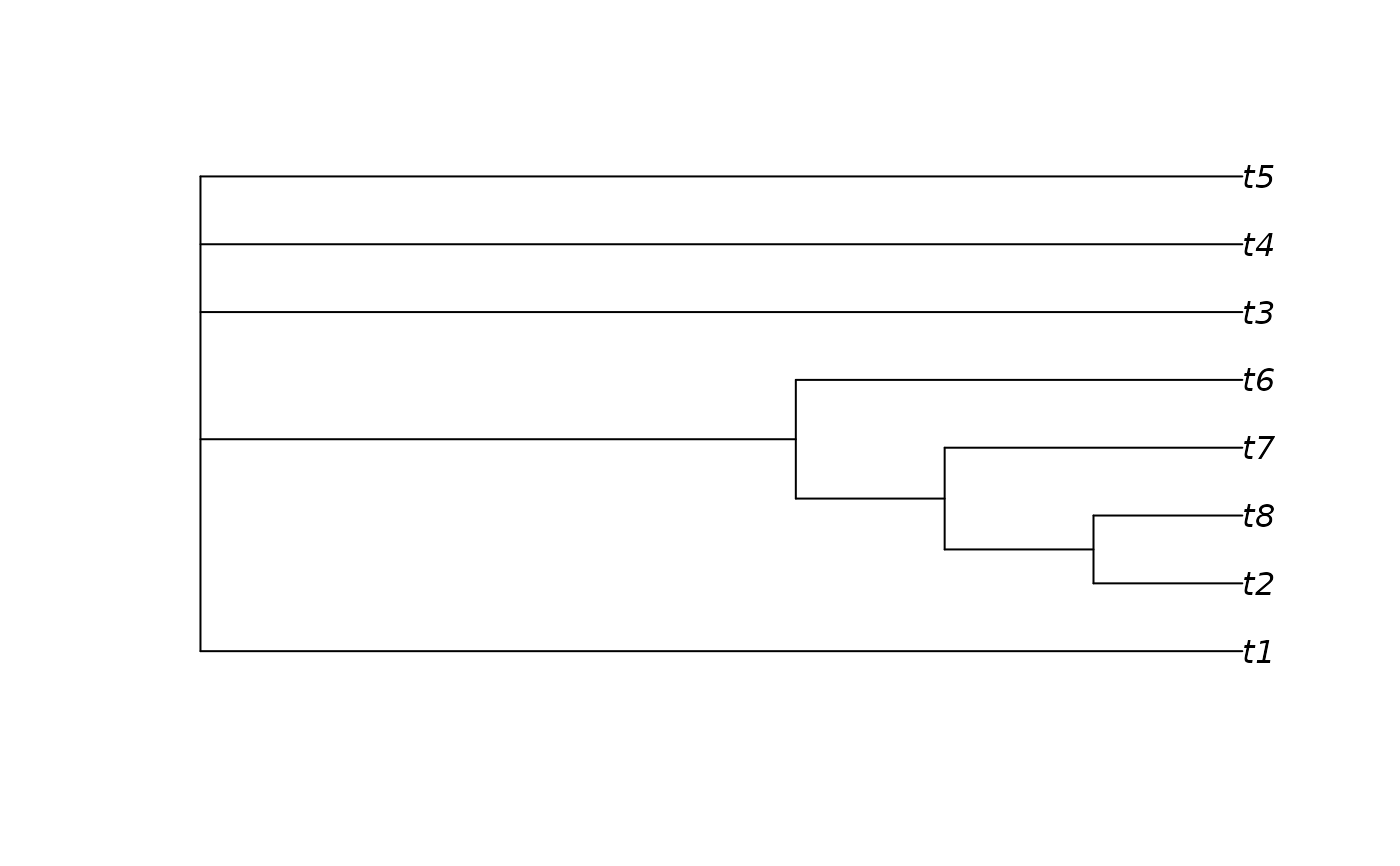
qc <- Quartet(trees)
plot(qc)
 # Compare resolution with majority-rule
mr <- UnrootTree(Consensus(trees, p = 0.5))
cat("Majority-rule splits:", NSplits(mr), "\n")
#> Majority-rule splits: 2
cat("Quartet consensus splits:", NSplits(qc), "\n")
#> Quartet consensus splits: 3
# Compare resolution with majority-rule
mr <- UnrootTree(Consensus(trees, p = 0.5))
cat("Majority-rule splits:", NSplits(mr), "\n")
#> Majority-rule splits: 2
cat("Quartet consensus splits:", NSplits(qc), "\n")
#> Quartet consensus splits: 3