‘ConsTree’ condenses a collection of phylogenetic trees – a bootstrap or Bayesian posterior sample, perhaps – into a single summary tree. It implements two categories of method: (i) those that retain groupings based on a voting rule; and (ii) summary trees selected based on their distance from other trees in the sample.
# Load packages with:
library("ConsTree")
library("TreeTools", quietly = TRUE)
Split-selection methods
The split-selection methods differ only in which groupings they keep, so they form a nested sequence of increasing resolution. To see this, take seven trees that share a backbone but disagree on the placement of a few leaves:
trees <- ape::read.tree(text = c(
  "((((((t1,t3),t2),t4),(t5,t6)),t7),(t8,t9));",
  "((((((t1,t3),(t5,t6)),t4),t2),t7),(t8,t9));",
  "((((((t1,t2),t3),t4),(t5,t6)),t7),(t8,t9));",
  "(((((t1,(t2,t3)),(t5,t6)),t4),t7),(t8,t9));",
  "((((((t1,t2),t3),t4),(t7,(t5,t6))),t9),t8);",
  "((((((t1,t3),t2),(t5,t6)),t4),t7),(t8,t9));",
  "((((t1,((t2,t3),(t5,t6))),t4),(t8,t9)),t7);"))
# Colour leaf labels consistently
nTip <- 9
leafCol <- setNames(hcl.colors(nTip + 1), TipLabels(nTip + 1))
plotCons <- function(tree, main = "") {
  plot(tree, tip.color = leafCol[tree$tip.label], main = main,
       font = 2, cex = 1, edge.width = 1.5)
}
oldPar <- par(mfrow = c(2, 4), mar = c(0.5, 0.5, 1.5, 0.5))
for (i in seq_along(trees)) plotCons(trees[[i]], main = paste("Tree", i))
par(oldPar)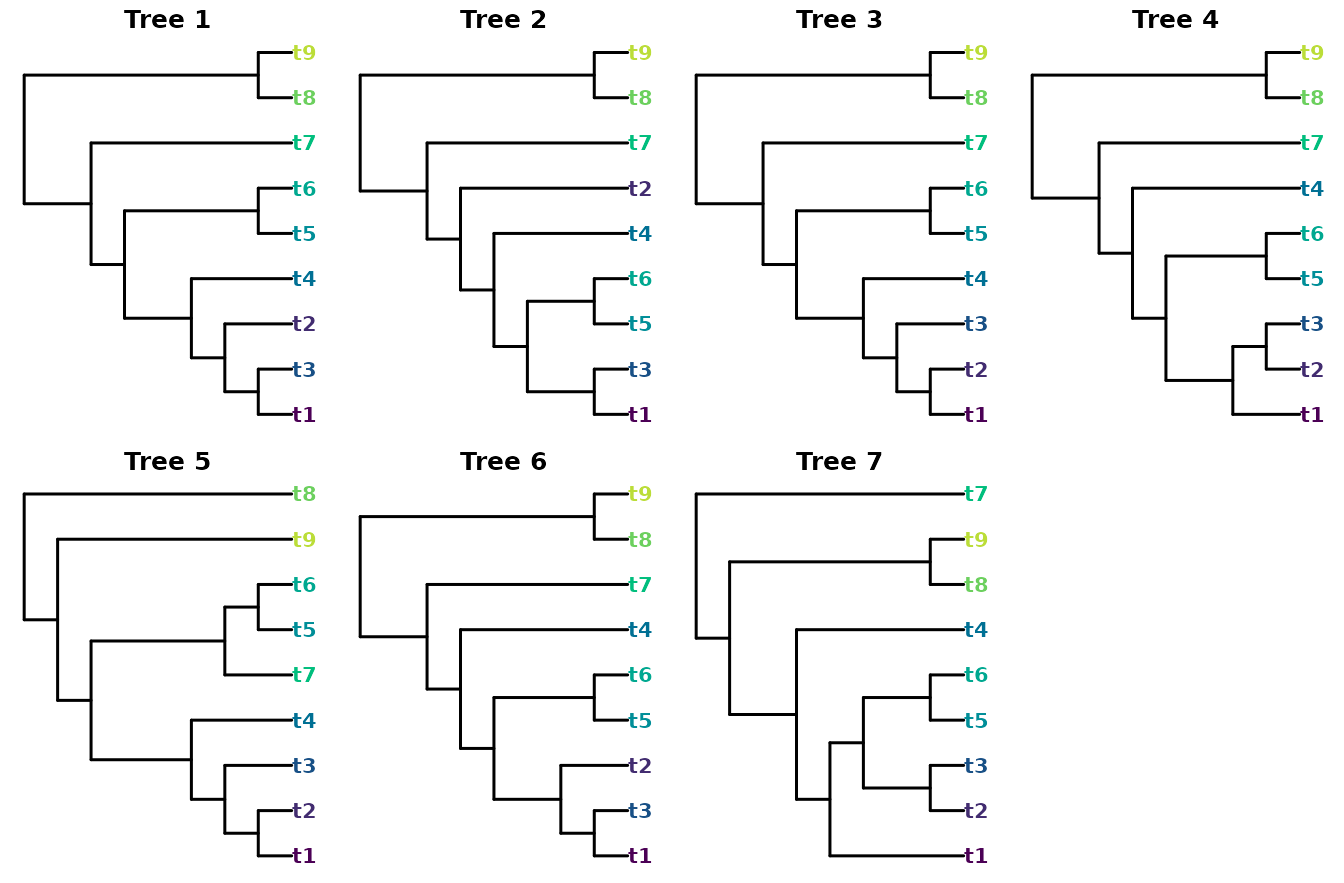
Each method retains a superset of the groupings kept by the one before it:
oldPar <- par(mfrow = c(2, 2), mar = c(0.5, 0.5, 1.5, 0.5))
plotCons(Strict(trees),    "Strict")
plotCons(Majority(trees),  "Majority-rule")
plotCons(Frequency(trees), "Frequency difference")
plotCons(Greedy(trees),    "Greedy (extended majority)")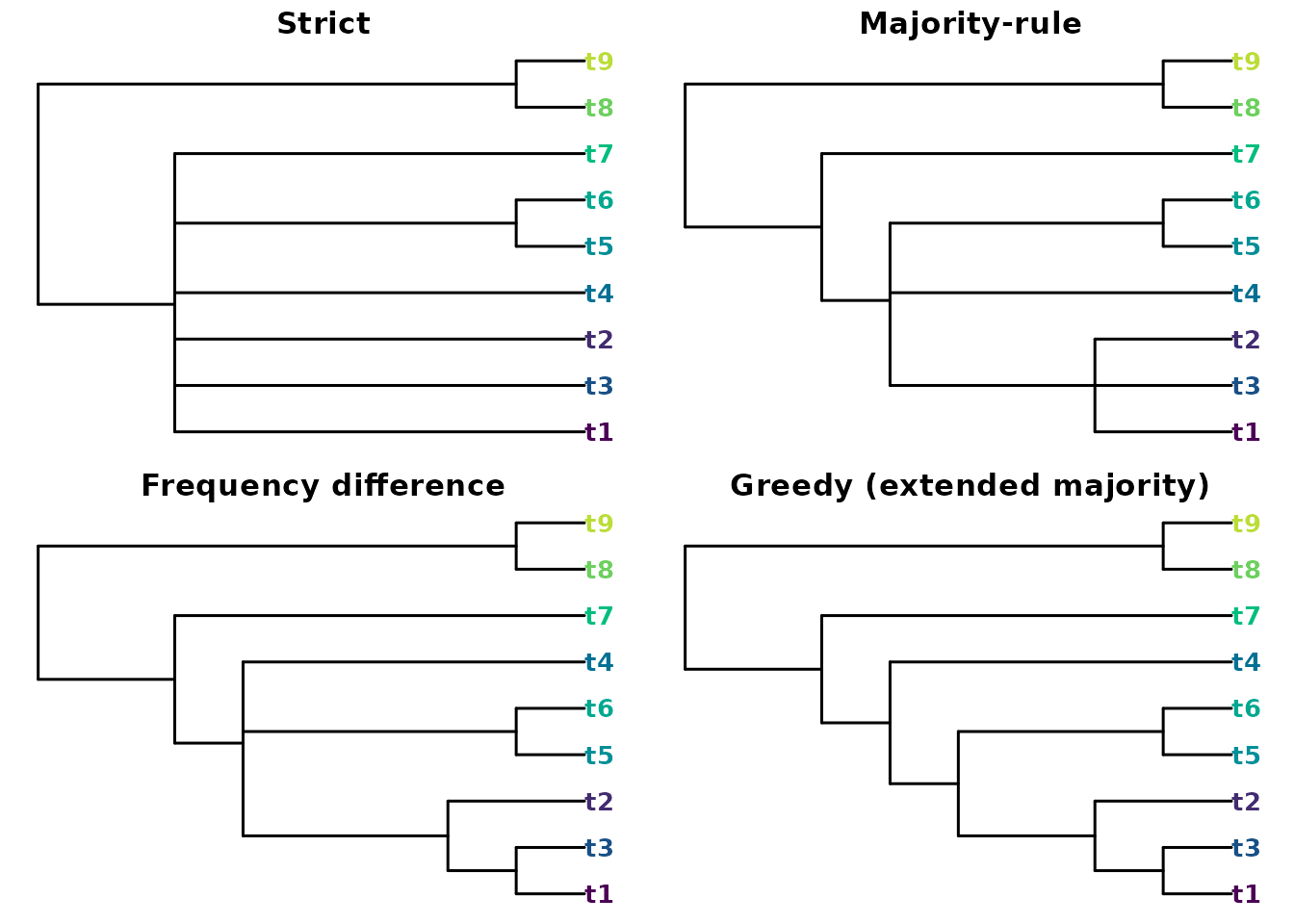
par(oldPar)
data.frame(
  method  = c("Strict", "Majority", "Frequency", "Greedy"),
  splits  = c(NSplits(Strict(trees)),    NSplits(Majority(trees)),
              NSplits(Frequency(trees)),  NSplits(Greedy(trees)))
)
#>      method splits
#> 1    Strict      2
#> 2  Majority      4
#> 3 Frequency      5
#> 4    Greedy      6
Strict() keeps only the two groupings that occur in
every tree; Majority() adds those that occur in more than
half; Frequency() keeps any grouping that beats every
grouping it conflicts with; and Greedy() adds compatible
groupings, most frequent first, giving the most resolved summary.
Simply counting splits overlooks the possibility that some splits are
more heavily contradicted by other trees. Loose() (the
semi-strict, or combinable-component, consensus) keeps every grouping
that no tree contradicts, whereas MajorityPlus() keeps any
grouping that is displayed by more trees than contradict it.
Rooted methods
Adams(), RStar() and Local()
treat the input as rooted and reason about clusters and
rooted triplets rather than unrooted splits. They may therefore recover
structure that an unrooted strict consensus would collapse:
rTrees <- ape::read.tree(text = c(
  "((((t1,t2),t3),(((t5,t6),t4),t7)),t8);",
  "(((((t1,t2),t3),(t5,(t6,t4))),t7),t8);",
  "(((((t1,t2),t3),((t5,t4),t6)),t7),t8);",
  "((((((t1,t2),t4),(t5,t6)),t3),t7),t8);",
  "((((((t1,t2),t3),t4),(t5,t6)),t7),t8);",
  "(((((t1,t2),t4),(t3,(t5,t6))),t7),t8);"))
oldPar <- par(mfrow = c(2, 3), mar = c(0.5, 0.5, 1.5, 0.5))
for (i in seq_along(rTrees)) plotCons(rTrees[[i]], main = paste("Tree", i))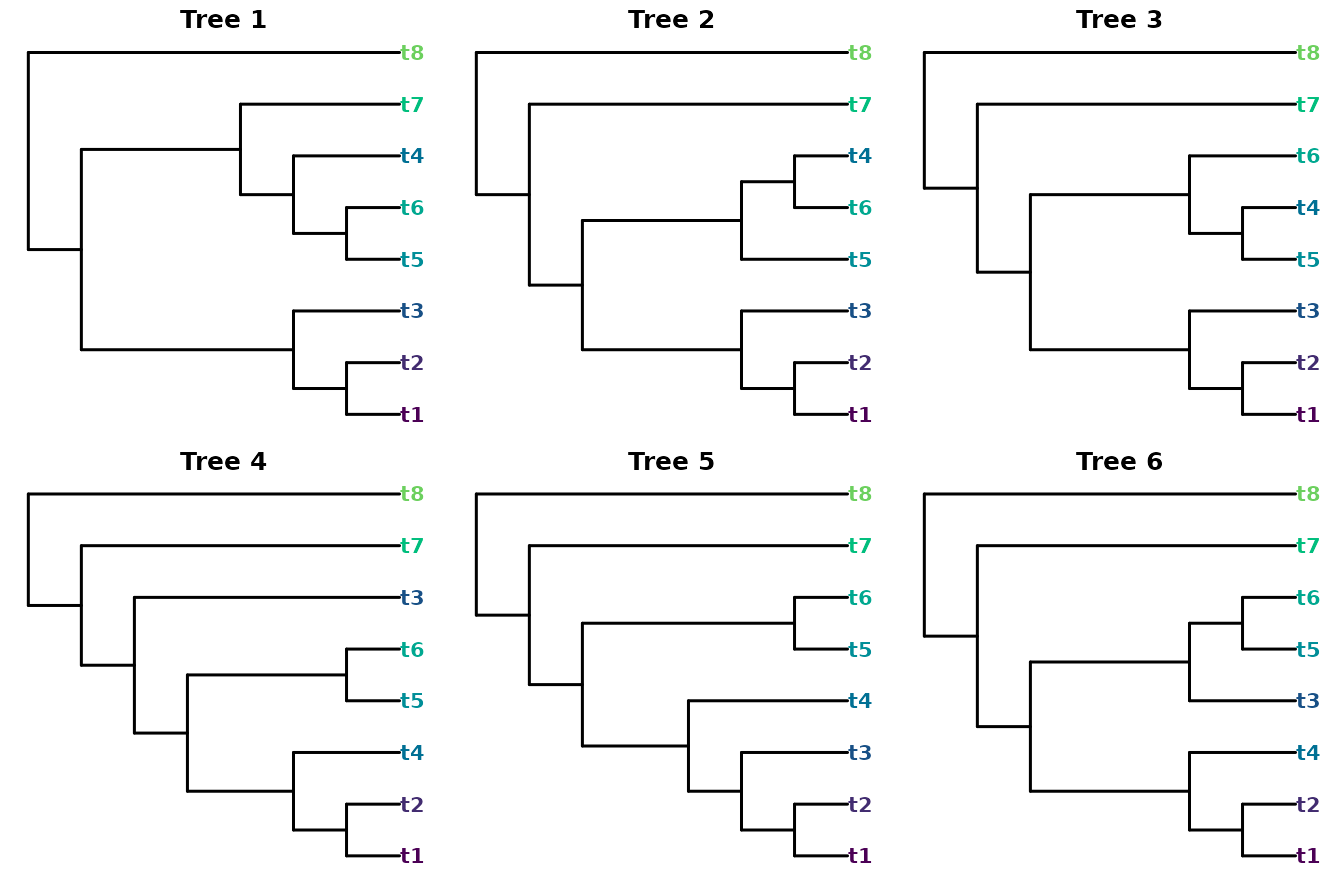
par(oldPar)The unrooted strict consensus keeps a single grouping, but the rooted methods recover more:
oldPar <- par(mfrow = c(2, 2), mar = c(0.5, 0.5, 1.5, 0.5))
plotCons(Strict(rTrees), "Strict")
plotCons(Adams(rTrees),  "Adams")
plotCons(RStar(rTrees),  "RStar")
plotCons(Local(rTrees),  "Local")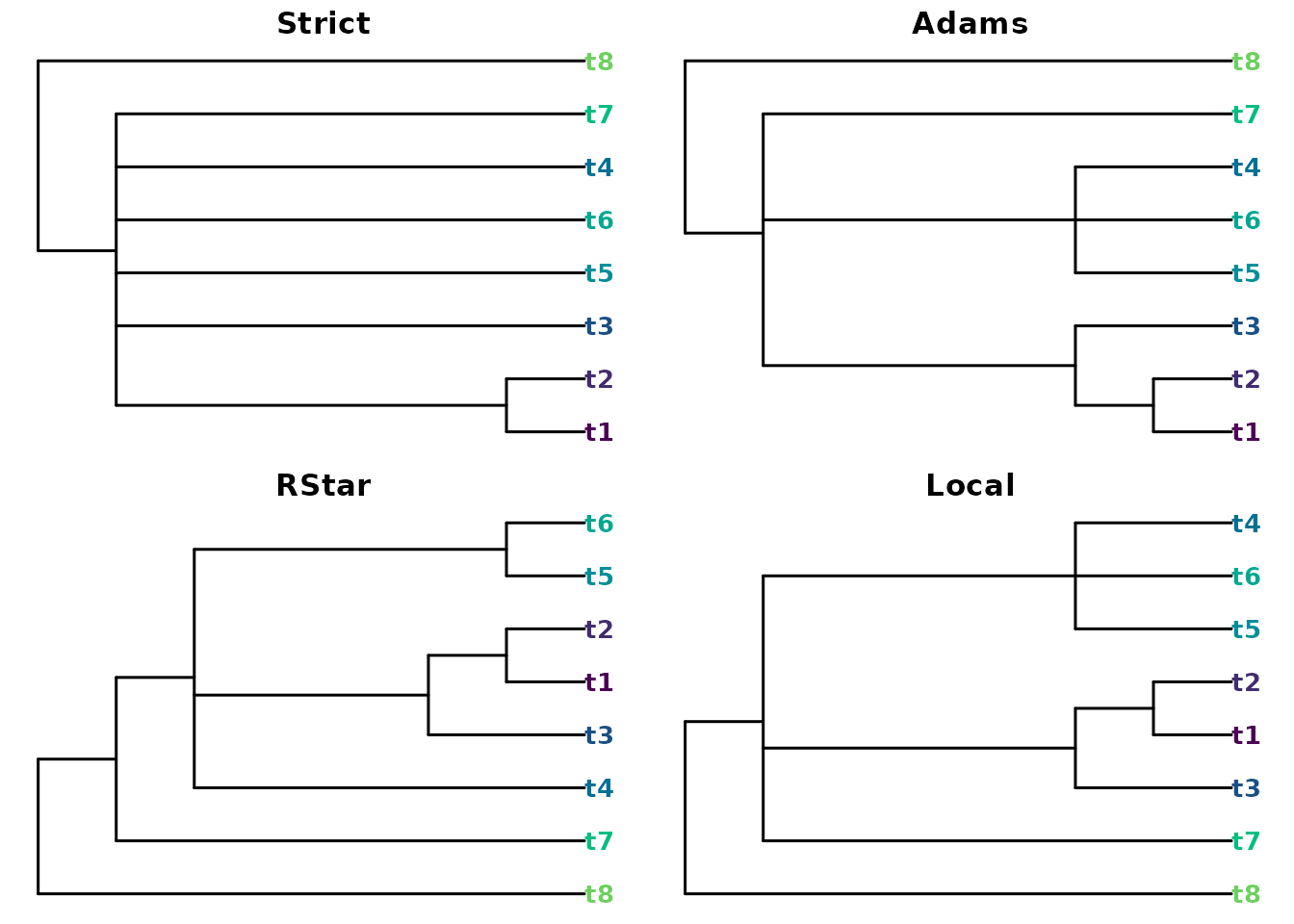
par(oldPar)
data.frame(
  method = c("Strict", "Adams", "RStar", "Local"),
  splits = c(NSplits(Strict(rTrees)), NSplits(Adams(rTrees)),
             NSplits(RStar(rTrees)),  NSplits(Local(rTrees)))
)
#>   method splits
#> 1 Strict      1
#> 2  Adams      4
#> 3  RStar      4
#> 4  Local      3
An Adams() consensus may display groupings that no input
tree contains. RStar() keeps each rooted triplet that wins
a plurality over both alternatives; Local() returns the
minimum local consensus of the shared triplets (limited to 20 leaves,
and best suited to congruent samples).
Distance and branch-length summaries
Maximizing the counts of individual groupings is equivalent to finding the tree with the minimum total Robinson–Foulds distance to all input trees. As the Robinson–Foulds distance exhibits shortcomings (Smith, 2020), other distance measures potentially provide more instructive summary trees.
Quartet() is the quartet-distance analogue, seeking (an
approximation to) the tree that minimizes the total quartet distance to
the inputs instead (Takazawa et al.,
2026). Because the quartet distance gives extra weight to deep
branches, the result is often more resolved than the majority-rule
tree:
c(majority = NSplits(Majority(trees)),
  quartet  = NSplits(Quartet(trees)))
#> majority  quartet
#>        4        5
median.multiPhylo() in the ‘TreeDist’ package allows
such a median to be selected from within a sample of trees under any
metric; unlike the previous approaches, this is restricted to tree
topologies within the sample.
When the trees carry edge lengths, two further summaries become
available. Average() returns the tree whose path-length
(patristic) distances best match the average of the input distance
matrices, while BHVMean() computes the Fréchet mean in
Billera–Holmes–Vogtmann treespace, with branch lengths;
BHVDistance(), BHVPairwiseDistances() and
BHVVariance() provide the underlying geodesic distances and
dispersion.
blTrees <- ape::read.tree(text = c(
  "(((t1:0.64,t2:0.84):0.52,(t3:0.84,t4:0.87):0.42):0.46,(t5:0.68,t6:0.34):0.70,t7:0.42);",
  "(((t1:0.64,t2:0.40):0.72,(t3:0.87,t4:0.38):0.87):0.41,(t5:0.58,t6:0.63):0.80,t7:0.63);",
  "(((t1:0.53,t2:0.50):0.78,(t3:0.66,t4:0.37):0.66):0.40,(t5:0.65,t6:0.68):0.48,t7:0.61);",
  "(((t1:0.48,t2:0.47):0.31,(t3:0.46,t4:0.73):0.79):0.65,(t5:0.87,t6:0.34):0.84,t7:0.75);",
  "(((t1:0.85,t2:0.47):0.71,(t4:0.72,(t5:0.78,t6:0.87):0.62):0.36):0.42,t3:0.37,t7:0.46);"))
meanTree <- BHVMean(blTrees)
oldPar <- par(mfrow = c(2, 3), mar = c(0.5, 0.5, 1.5, 0.5))
for (i in seq_along(blTrees)) plotCons(blTrees[[i]], main = paste("Tree", i))
plotCons(meanTree, main = "BHV mean")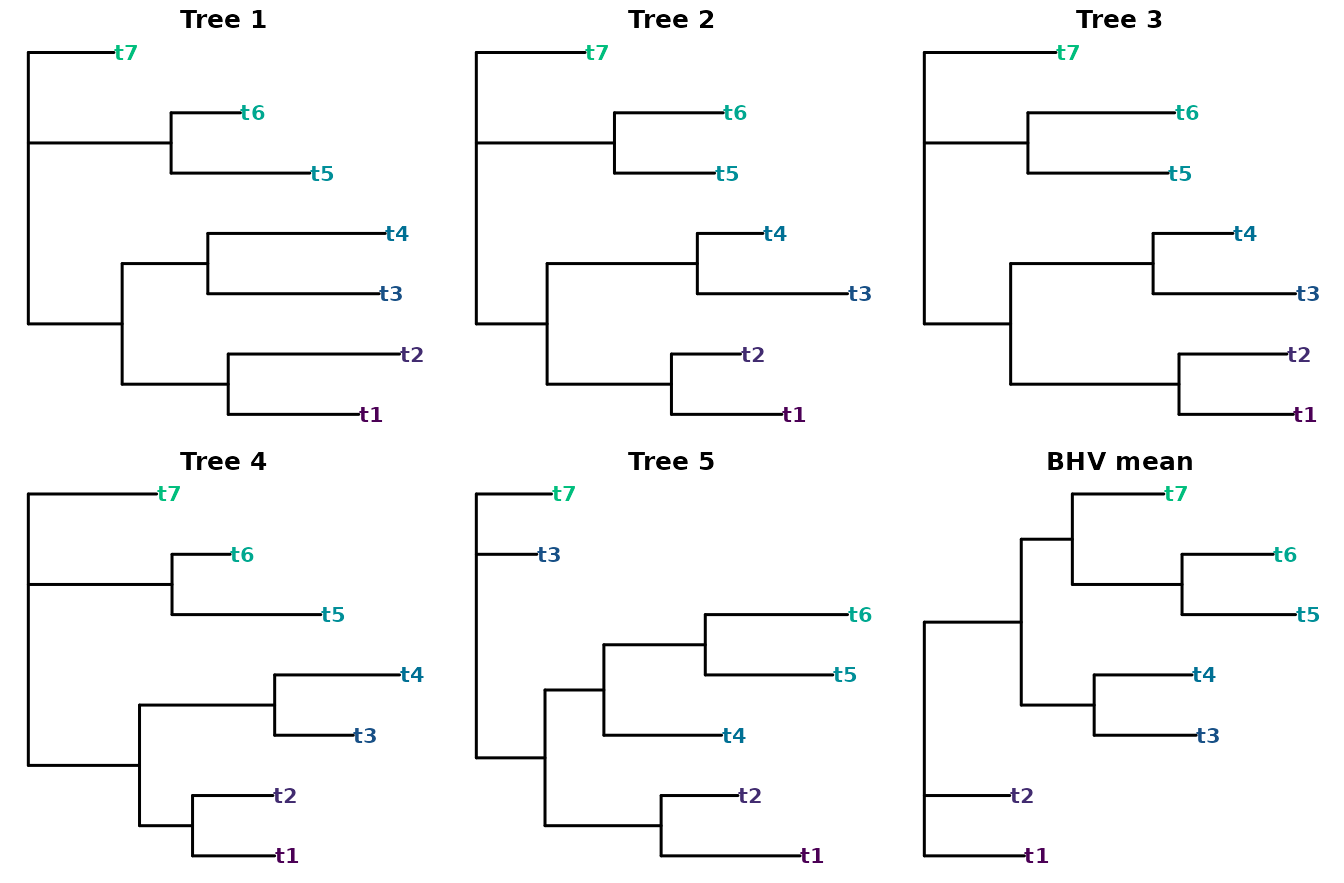
par(oldPar)
BHVVariance(blTrees, mean = meanTree)
#> [1] 0.5749739
The mean recovers the shared topology. The two groupings that every tree displays keep their full length; the two that the fifth tree contradicts exhibit shorter branches.
Method selection
The most appropriate method in a particular circumstance depends on the value of precision versus accuracy; trees that resolve more groupings are progressively less likely to be accurate (Smith, 2019).
By omitting unstable leaves from the input trees, perhaps via the ‘Rogue’ package, it is possible to improve the resolution of consensus trees by reconciling groupings that only differ in the position of rogue taxa (Smith, 2022).